Homebrew Experiment
Can Two Cans of Coopers Lager Make a Good Brew?
Using two cans of malt can make a handy stout, but could two tins of Coopers Lager make a decent beer? There was only one sensible way to find out.
My local supermarket had Coopers beer kits marked down to a very cheap $11 each, around $8 or $9 off the usual price. I checked the best-before date, which was mid-2023, so the yeast did not appear to be stale.
That was enough justification for me. I put all seven cans on the shelf.
The original plan involved adding some dry malt extract, but the supermarket had no DME. Sad face.
So this became a very simple double-kit experiment. Two tins of Coopers Lager. No DME. No enhancer. No extra sugar in the fermenter. No additional hops.
That matters because two kits in one batch do not simply make an ordinary lager with twice the flavour. They make a much more concentrated wort, with more malt, more body, more potential alcohol and less margin for error. It can work very well, but it needs to be treated as a deliberately bigger beer rather than a routine one-can brew.
The double Coopers Lager brew day
I prepared the batch in the standard kit-beer fashion. The fermenter was sanitised, the spoon was cleaned, boiling water was added to loosen the malt extract, and both cans were stirred through until properly dissolved.
Once the malt was in solution, I added roughly 20 litres of water, gave the wort a thorough stir, and pitched the yeast in the customary manner. The fermenter then went into the cool cupboard off to the side of our kitchen.
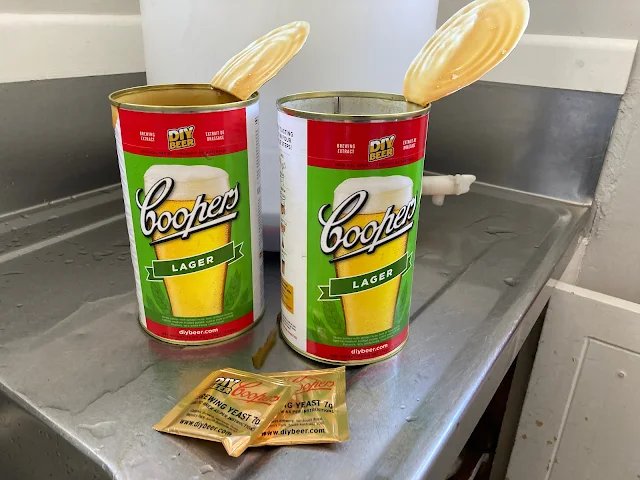
Two Coopers Lager kits, no DME, no enhancer and no extra hops. A simple brew on paper, but a stronger one than the standard kit recipe.
There is a useful lesson in that simplicity. A beer kit already gives the brewer a malt base, bitterness and a rough flavour direction. The real work comes from yeast health, temperature control, sanitation, patience and packaging. Those decisions have more influence over the final bottle than most beginners expect.
More malt weight
The beer should be fuller, stronger and more substantial than a single can brewed to standard volume. That can be welcome in a stout, an ale or a winter beer. It is harder to pull off when the target is a crisp, easy-drinking lager.
More patience
A heavier wort may need longer to ferment and settle. Calendar days can be useful as a guide, but stable hydrometer readings are the better confirmation that the beer is actually ready to bottle.
Bottling the lager
After about a week or so, I bottled the lager into some green Grolsch bottles that my generous neighbour had given me, along with a few extra bottles that are not pictured.
They were then left to condition in the shed for around two weeks.
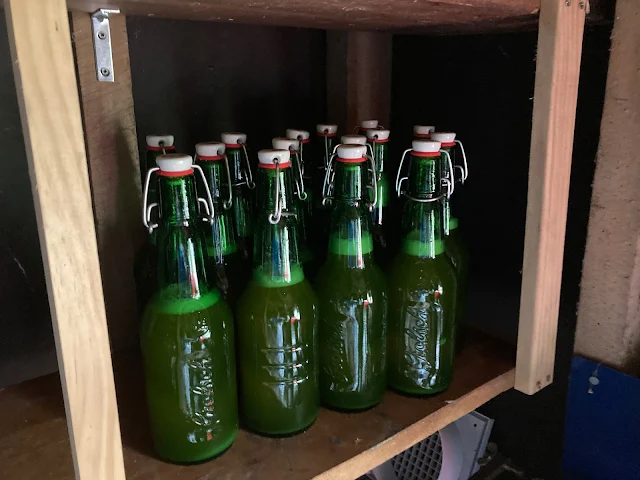
The batch went into green Grolsch bottles for conditioning in the shed.
The sediment had settled and the beer looked fairly clear, so I grabbed a couple of bottles and put them in the fridge.
On Friday night, after a hard day shuffling paperwork around the office, I decided it was time to see whether the two-can experiment had produced a deliciously quaffable beer.
No, dear reader. I had made ice cream.
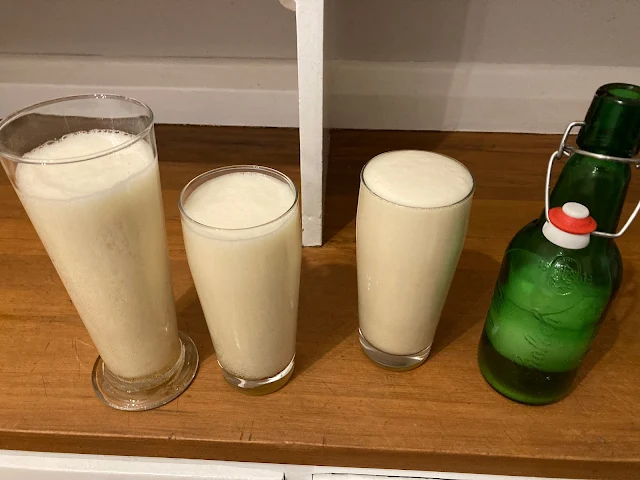
An over-carbonated pour. The beer had plenty of pressure, but not in the helpful way.
Why was it so over-carbonated?
It appeared that my beer was over-carbonated.
Two cans of malt did not automatically create that excess carbonation. Bottle carbonation comes from the priming sugar added at packaging, plus any fermentable sugars that may still have been left in the beer. However, a stronger double-can wort can take longer to finish fermenting, which makes it more important to confirm that fermentation has properly ended before bottling.
Perhaps I had added too much sugar at bottling. I am less inclined to think that was the only reason, because I had brewed a few beers by then and felt I had the required sugar content largely under control through batch priming.
But this batch was a useful reminder that a bigger beer needs a little more discipline. Before bottling a two-can brew, it pays to check that the final gravity is stable over a couple of readings, calculate priming sugar from the actual volume of beer being bottled, and make sure the priming solution is mixed evenly through the batch.
So was the beer any good?
At the two-week point, the beer had room for improvement. It felt thicker in the mouth than a standard lager should taste. It was not as sweet as Coopers Lagers generally taste, but it was not dry either.
There was a slight hint of a whiff of something that I could not quite decode. The beer was best served very cold, because that flavour became more obvious as it warmed up. Another few weeks of conditioning may well have softened it, but there was no guarantee that time alone would turn this into a clean, crisp lager.
The extra malt had made the beer feel bigger and broader than expected. That was not necessarily bad, but it pushed the batch away from easy-drinking lager territory and towards something heavier, slightly rougher and more difficult to place.
What this says about making beer from kits
Kit brewing is not simply a shortcut. A good kit gives you concentrated malt wort and a workable flavour base, then leaves the brewer to control the parts that matter most: sanitation, temperature, yeast, volume, carbonation and conditioning time.
A single kit with DME can be a tidy way to build malt body without taking the beer too far from its intended style. Two kits can also work well, especially when you want a stronger ale, stout, porter or winter warmer. For a lager-style beer, it is worth thinking carefully about whether you want extra richness and strength, or whether you are actually chasing a lighter, cleaner finish.
Using two cans is best treated as a recipe decision. Consider the final volume, use healthy yeast, avoid rushing the fermentation, and take gravity readings before you prime and bottle. A notebook with the kit names, water volume, yeast, fermentation temperature, gravity and priming sugar makes each future batch easier to improve.
Make the brew closer to the intended finished volume, rather than concentrating both tins too heavily into a smaller batch.
Confirm fermentation has finished with stable gravity readings, rather than relying on the number of days the fermenter has been sitting.
Use a measured batch-priming calculation based on the true amount of beer being bottled, and stir gently enough to distribute the sugar without splashing oxygen into the beer.
Give the bottles time. A beer that is merely drinkable at two weeks can often become more settled and balanced after another few weeks in cool, dark storage.
Final verdict on two tins of Coopers Lager
The final result was an okay beer, but not one I would try to reproduce in exactly the same way. Two Coopers Lager kits can make a drinkable brew, but this batch was too thick, too fizzy and not crisp enough to become a regular recipe. The experiment was still worthwhile. It proved that kit brewing rewards simple recipes, careful fermentation and a willingness to learn from the bottles that come out looking more like ice cream than lager.
