Bluelab pH Combo Meter - Review 2020

Sunday, February 27, 2022

Review: Bluelab Combo Meter for your pH measuring needs


If you are looking for an upmarket solution to measure and meet your pH solution needs then the tried and true Bluelab brand has the measuring device you are looking for:

Bluelab has a reputation for making devices that help with crop management, soil testing, nutrient meters, and home-based hydroponics.

It's apparently really popular with marijuana enthusiasts in California and kombucha makers everywhere!

The Bluelab Combo Meter has the triple functionality of being a portable pH tester, conductivity reader and temperature taker all in one. This can be quite a handy combination for home brewing
enthusiasts!

Blue Lab Combo Meter for pH, Temperature and Conductivity

The meter has two probes, a Bluelab pH probe, and a Bluelab Conductivity and Temperature probe. When taking a reading, simply place them into the solution and the selected reading is displayed on the screen. 

best reviewed bluelab ph testerDead easy.


The beauty of the Bluelab system is that all their probes are compatible with their entire range. As with most decent pH testers, you'll need to purchase probe storage solution to maintain and prolong the life of the probe.

Calibration of the pH probe is quite simple as instructions are supplied on the back of the meter and the easy 'push button method' makes this one of the simplest meters to use for your brewing needs.

That said, there are plenty of mistakes people make when using meters, especially when calibrating.

The pH probe is quite replaceable so you can use this meter for many years to come. You should be able to do this as Bluelab offer a 5 year warranty on their product!

This surely gives you an idea as to the quality of the product and the faith the brand has in it. 

By utilizing the temperature function of the unit, you'll be able to take accurate readings during the boil and quite importantly, after you've cooled the wort sufficiently, you'll be able to record the correct temperature at which to pitch the yeast - old hands will know that if  you pitch yeast into a wort that's too hot, you will kill the yeast and no fermentation will begin. 

The Bluelab meter has the following features:

  • Measures pH, conductivity / nutrient (EC, CF, ppm 500 and ppm 700) and temperature (°Centigrade & Fahrenheit)
  • It's very lightweight and portable
  • Large easy to read display screen
  • Simple push-button operation for pH calibration
  • Successful pH calibration indication
  • No calibration is required for conductivity and temperature measurement taking
  • The double junction pH probe is easily replaceable 
  • Over range and under range indicators
  • Low battery level indicator
  • Two x AAA alkaline batteries included so you can start taking measurements immediately
  • Auto off function to make sure that the battery doesn't wear down.
  • Five year warranty for the unit itself, and six months for the probe.

Because of its demonstrated quality, this is a pricey unit but well worth it if you are a regular brewer who needs to monitor the hydrogen potential of their beer!

If you are looking for a mid-price range metering device, Blue Lab's portable pens are in the hundred dollar range. They are quite portable and come with a conductivity probe care kit.


good ph tester for home brewing

Here's some reviewer comment from happy buyers on Amazon:

"I am going on 6 months and it hasn't even needed to be re-calibrated."

"Very accurate. Nice meter, the ph probe is extremely fragile, do not tap this probe on anything or it will break" (This is a pretty common occurrence with most glass probes so is not necessarily a design flaw in the product and replacement is an easy process - Ed)

"Be sure to do the recommended meter maintenance and proper storage of probes."

"Recommended if precision means everything to you! Calibrate twice a month minimum if used daily, and buy some storage solution for the probe! It doesn't come with any extra storage solution, but it is a MUST to get some as well as extra 4.01 and 7.01 buffer solutions and you're set for a while!"

And finally this absolute gem of a product endorsement & review from a user:

"Easy to use. Worked right out of the box. Easy to calibrate and maintain. I'd wanted one for years but didn't want to spend the $$. Well, I'll tell you, it was worth it. I never knew how far off I was with just using measurements and test strips. The next batch that I produced using accurate measurements with the combo meter was astounding. Try it and see the difference."


Here's the official video from Bluelab which shows you how to prepare the meter for its initial use and how to correctly calibrate the device with the proper buffer solutions.


When should I clean the Blue Lab ph Meter?


For accurate pH readings the pH probe should be properly cleaned and then re-calibrated when:
  • when the on screen reading is quite different from what you were expecting. 
  • when the batteries have been run flat, removed or changed. This is because the device forgets its readings.
  • when the pH probe is replaced with a new one or is disconnected from the Combo Meter.
  • the pH calibration indicators have disappeared from the unit. 
When calibrating the pH after the machine's first use, the pH probe needs to be cleaned after each subsequent use.

How to correctly calibrate the meter


To obtain a correct pH calibration reading, the unit's accuracy is very dependent on the accuracy and age of the calibration solutions used, and the condition and cleanliness of the pH probe tip. You will get a calibration error if the unit is not properly maintained as per the instruction manual.

For best results, the user must ensure the pH probe has been cleaned and that it is rinsed with clean water between calibration solutions to reduce contamination of the pH solutions.

One should only use fresh and uncontaminated solutions. This means if your buffer solution has been sitting open on a shelf for a couple of years, you probably should obtain a new batch.

It's also best practice to calibrate the pH at the same temperature as the solution to be measured. 


good ph tester for home brewing

If you're not sold, you could consider these ph pens or check out our guide to five other top rated pH Testers.
Brewing with two Coopers Lager Beer Kits

Saturday, February 19, 2022

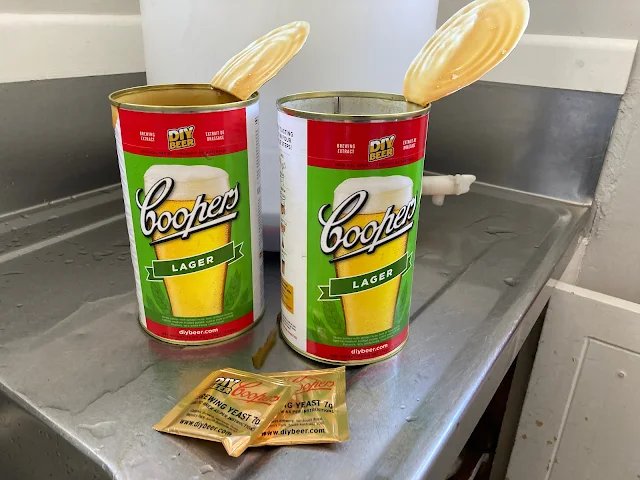
If using two cans of malt can make a handy stout, can two tins of Cooper's lager make a good brew?


Let's find out. 


My local supermarket had Coopers beer kits for a super cheap 11 dollars which was about 8 - 9 bucks off the usual price. 


I checked the expiry date and it was for mid 2023 so the yeast would not be stale. 


So what the heck, I put all 7 cans on the shelf. 


But the supermarket had no DME. 


Sad face. 


So I decided to be brave and use two cans of the lager malt together. 


No DME


No enhancer


And no hops


So I prepared the double batch in the standard way. Sanitised the fermenter drum. Clean the spoon. Added so boiling water. Added the lager malt. Stirred the lager malt. Added 20 odd litres of water. Pitched the yeast in the customary manner. Stored the lager in the cool cupboard off to the side of our kitchen. 


two malt cans of lager batch


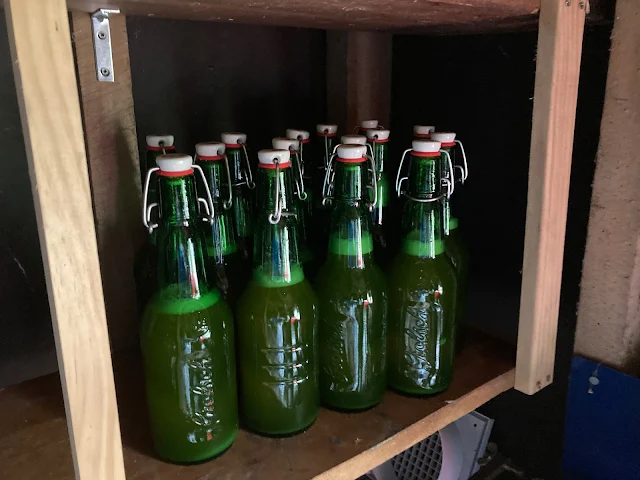
After about a week or so I bottled the lager brew into some green Grolsch bottles, my kind neighbour gave me. Plus a few extras that are not pictured!

These were left to condition in my shed for about two weeks. 

bottle condition lager


The sediment had settled and the beer looked fairly clear so I grabbed a couple and put them in the fridge. 


On Friday night after a hard day shuffling paperwork around the office I decided to try the lager. 


What had a made? A deliciously quaffable beer? 


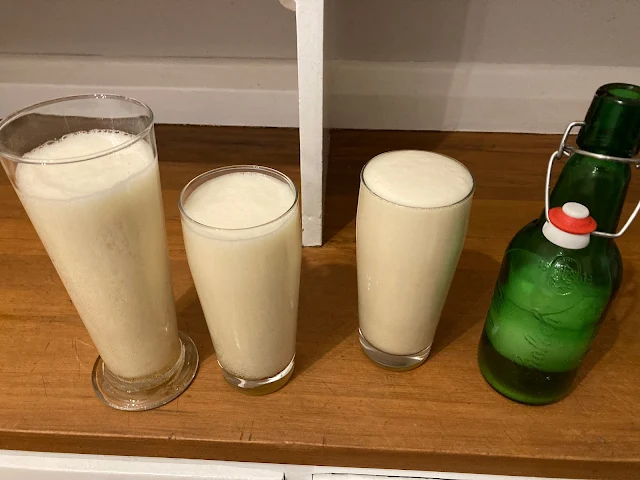
No dear reader, I had made ice cream:

over carbonated beer


It would appear my beer was over carbonated. 


This is was not necessarily a surprise as two cans is a lot of food for the yeast to make into alcohol and CO2. 


Perhaps I had added too much sugar at bottling? I'm less inclined to think that the cause as I have brewed a few beers in my time and feel I have got the required sugar content down these days by batch priming


So if using two kits, be mindful of that. 


So was the beer any good?


At the two week point, this beer has room for improvement. It feels thicker to the mouth than a standard lager should taste. It is not as sweet as Cooper's lagers generally taste and it is not dry either. 


It was a slight hint of a whiff of something that I cannot quite decode - I suspect this beer will be best served very well chilled as that whiff dominated the beer as it warmed up. An extra week or three of conditioning may see that whiff of taste disperse. 

The final result was an OK beer result but not one I'd try to reproduce. 

HOPS BREWING KITS COOPERS


Effective Tips for Removing Beer Sediment from Bottles

Friday, February 11, 2022

How to reduce the amount of sediment in beer bottles


Once you've bottled your beer and let it condition a little bit, you may notice that some sediment or sludge has formed at the bottom of the beer bottle, kind of like it did in your initial fermentation device (that's called the trub).

This is very normal and is not an indication of there being anything wrong with your beer.

The sediment occurs as a result of fermentation. It is the residue of yeast and proteins and maybe some hops.

During the secondary fermentation round, the yeast has eaten the sugars, fermented and dropped to the bottom of the bottle.

Does it affect the beer in any way?

Not really.

how to reduce sediment from beer bottles

The key thing is that when you pour beer, you'll want to ensure that you pour the beer out fully but halt the pour just when the sediment is about to exit the bottle neck.

You're aiming to leave about the last quarter to half inch of beer in the bottle. Make sure your glass or stein is big enough to take the whole pour.

If you have to stop and start the pour, there's a good chance you'll stir up the sediment.

While the residue is quite drinkable, it will make the color of your beer go cloudy. Given a good beer color is part of the drinking experience, many drinkers will avoid pouring the sediment in.

In my experience, it does not affect the taste of the beer and it will most certainly not make you sick.

If you are keen to ensure you have 'clear beer' there are some tips and tricks you can do to reduce the amount of sediment.

You're not likely to remove it all but by using the cold crash technique before you bottle, you'll remove some of the post-primary proteins.

Cold crashing is when you place your fermentation drum or carboy inside a fridge for a minimum period of 24 hours AFTER primary fermentation has occurred. The chill causes the proteins and yeast to fall out of the beer solution and to the bottom of the fermenter.

Many brewers will have a fridge in their shed which they have connected to a brewing thermostat which regulated the temperature of the beer. This is a very handy trick for when you are trying to properly regulate the temperature of your brew (and it is so very important to ensure your beer is brewed at the correct temperature! Heat has an amazing influence on beer at various stages.

When you bottle you have two choices, you can bottle straight from the fermenter or you can transfer the beer into a secondary container by way of siphoning from one drum to another. In this manner, you are leaving the sediment caused by the cold crashing in the first vessel, meaning there will be less sediment in the bottles.

Commercial breweries, including craft brewers, will actually use a filtration system on their brew to remove the sediment. This process removes the yeast so they will then repitch so that the beer will carbonate. Sediment can also be removed by use of a centrifuge, which is possibly beyond the realm of back yard brewers.

You can also add what are called beer finings, which can improve the clarity of beer.

If you are brewing a Belgian style beer, it's important to recognize that Belgian beers usually use special yeasts and wheat so haze and sediment are normal for that style.

Here's a list of things you can do in the brewing process to help reduce sediment:

  1. Do your boil 'harder' so as to maximize the "hot break" – the coagulated proteins that float around during the boil.


Boiling your beer wort "harder" can improve the hot break, which is the coagulation of proteins during the boil. This can help with the removal of sediment and other unwanted particles in the beer. The hot break occurs when heat denatures the proteins, which then clump together and form a layer on top of the wort. This layer is then removed, resulting in clearer beer.


  1. Add whirlfloc or Irish moss a day or two before bottling to help with flocculation (yeast clumping together and then falling out).


Whirlfloc or Irish moss are fining agents that help to clarify beer. They work by causing yeast and other particles to clump together and settle at the bottom of the fermenter. This makes it easier to transfer the clear beer to the bottling bucket or keg. Adding these fining agents a day or two before bottling can help to improve the clarity of the beer.


  1. Before transferring to primary, whirlpool your kettle and give it a few minutes to settle.


Whirlpooling your kettle before transferring to the primary fermenter can help to remove sediment and other unwanted particles. This involves stirring the wort in a circular motion to create a vortex, which causes the sediment to collect in the center of the kettle. After the whirlpool, give the kettle a few minutes to settle, so the sediment can collect in one place before transferring to the fermenter.


  1. Don't try to transfer everything from the kettle. Minimize the amount of hops and hot break you transfer. You can filter at this stage; splashing a bit will help with aeration.


Transferring everything from the kettle can result in a lot of sediment in the fermenter. To minimize the amount of hops and hot break you transfer, you can use a strainer or filter when transferring the wort to the fermenter. Splashing the wort during this stage can also help to aerate it, which can improve fermentation and result in better beer.


  1. Delaying bottling as long as possible gives the yeast a lot of time to fully ferment.


Delaying bottling can give the yeast enough time to fully ferment the beer, resulting in better flavor and clarity. The longer the yeast has to work, the more it will consume any remaining sugars, resulting in a dryer and more carbonated beer. However, it's important not to wait too long, as this can result in over-carbonation or off flavors.


  1. Do a cold crash in a fridge.


Cold crashing involves cooling the beer to near-freezing temperatures before bottling or kegging. This causes any remaining yeast or other particles to settle at the bottom of the fermenter, resulting in clearer beer. Cold crashing can also help to reduce the risk of over-carbonation in the bottles.


  1. Add gelatin to improve beer clarity.


Gelatin is a fining agent that can help to improve beer clarity. It works by binding to any remaining particles in the beer, causing them to settle to the bottom of the fermenter. Gelatin is added after fermentation is complete, and the beer is then cold crashed to improve clarity further.


  1. Use a separate bottling bucket – transfer from the primary using a beer siphon. The intake is not quite at the bottom of the beer cake, so it helps to leave the yeast cake behind.


Using a separate bottling bucket can help to reduce the amount of sediment in the bottles. When transferring from the primary fermenter, use a beer siphon, and make sure the intake is not touching the bottom of the fermenter

If you need to remove beer sediment post-drinking the beer, a rinse under the kitchen tap is always very helpful but a 24 hour soak in a Powdered Brewery Wash solution will work wonders on your bottles
Powered by Blogger.

Tags

absorption caps abv acetaldehyde acid adjuncts advice about beer brewing aeration aeration kit aging air lock alcohol alcohol poisoning ale ale beer kits alkaline alkaline brewery wash all grain american amylase apera apples attenuation autolysis automatic temperature compensation bacteria baker's yeast baking yeast ball lock ball valve bar keepers friend barley batch prime beer brewing beer capper beer dispenser beer filtration kit system beer gushers beer kit beer kit review beer kits beer lines beer salt beer taps beerstone best brewing equipment biotin bittering BKF black rock bleach blichmann blow off tubing bluelab bohemian pilsner boil in a bag boil over boneface bottle cap bottle caps bottle conditioning bottling bottling beer bottling spigot bourbon brettanomyces brew and review brew day brewing beer guide brewing salts brewing spoon brewing sugar brewing thermostat brewzilla british thermal unit brix brix scale BTU budvar buffer buffer solution burton snatch buyer's guide calcium chloride calcium sulphate calibration calibration probe calibration solution campden tablets capping carbon dioxide carbonation carbonation drops carboy cascade caustic soda cherry wine chinook chlorine christmas chronicle cider clarity cleaning your equipment clear beer clone recipe cloudy beer cold crashing coldbreak conditioning tablets conductivity conical fermenter contamination coopers copper tun corn sugar cornelius corny keg craft beer creamy beer crown cryo hops cubes danstar nottingham demijohn dextrose distilation DIY DME dopplebock draught dry hopping dry malt extract edelmetall brü burner eisbock ekuanot electrode enhancer enzyme equipment ester ethanol experiments in beer making faucet fermcap-s fermentables fermentation fermenter fermentis fermentor final gravity finings five star flat beer floccing foam inhibitor force carbonation french fresh wort pack fridge fruit fusel alchohol garage project gas burners gelatin gift and present ideas gin ginger beer glucose golden ale golden syrup goldings gose grain grain mill green bullet grist guinness gypsum hach hacks hallertauer heat mat heat pad heat wrap home brew honey hop schedule hops hops spider how not to brew beer how to brew that first beer how to brew with a beer kit how to grow hops how to make a hop tea how to wash yeast hydrated layer hydrogen sulfide hydrometer IBU ideas idophor infection inkbird instruments isoamyl acetate jelly beans jockey box john palmer juniper keezer keg cooler keg regulators kegco kegerator kegging kegs kettle kombucha krausen lactic acid lager lagering lauter lion brown liquid malt extract litmus LME lupulin lupulin powder lupuLN2 making beer malic acid malt malt mill maltodextrin mangrove jack's maple syrup mash mash paddle mash tun mccashins mead methanol micro brewing milling milwaukee MW102 mistakes mixing instructions moa mouth feel muntons must nano brewing New Zealand Brewer's Series no rinse nut brown ale oak oak wood chips off flavors original gravity oxygen pacific gem palaeo water pale ale panhead parsnip PBW pear pectine pectolase perlick ph levels ph meter ph pen pH strips ph tester pico brewing pilsner pitching yeast plastic drum poppet valve pot powdered brewing wash ppm precipitated chalk pressure relief valve priming prison hooch probe problem solving propane and propane accessories pruno pump system purity law radler re-using yeast recipe record keeping reddit refractometer reinheitsgebot removing beer labels from bottles review rice hulls riwaka rotten eggs saaz saccharomyces cerevisiae salt sanitization secondary regulator sediment seltzer session beer silicon simple tricks for brewing siphon site glass skunked beer small batch brewing soda soda ash soda stream sodium carbonate sodium carbonate peroxyhydrate sodium hydroxide sodium metasilicate sodium percarbonate sour beer sparge spigot spirals spirits spoon spraymalt star san starch STC-1000 steinlager steralisation sterilisation sterilization sterliization still stoke storage solution stout sucrose sugar supercharger tannins temperature temperature controller therminator thermometer tips for beginners tri-sodium phopsphate tricks and tips trub tubing tui turkey vodka infused gin vorlauf water water testing wet cardboard taste wet hopping weta whirlfloc tablets white claw williamswarn wine winter brewing wood wort wort chiller yeast yeast energizer yeast nutrient yeast rafts yeast starter yeast traps zinc
Back to Top