Moving a full-volume brew out of the kitchen creates one immediate problem: a large kettle can overwhelm an ordinary cooktop. A purpose-built outdoor gas burner delivers more heat, supports a heavier pot and gives the brewer finer control as the wort approaches a boil.
Raw BTU output gets most of the attention, but it is only one part of the buying decision. A burner must fit the kettle, remain stable under its filled weight, hold a clean flame in normal wind and turn down far enough to control a threatening boilover. The correct hose, regulator and fuel connection matter just as much.

Choose the burner and stand as one system. A powerful flame under a poorly supported kettle creates a dangerous brew day.
Quick recommendations
- Best overall brewing burner: Blichmann HellFire Floor Burner.
- Best for maximum output at a lower purchase price: GasOne B-5450.
- Best for smaller kettles and moderate heat: Bayou Classic SQ14 Patio Stove.
- Best limited-availability specialist option: Edelmetall Brü Burner.
- Best reason to reject any burner: the kettle does not sit fully supported and stable on its frame.
Outdoor use means fully outdoors
These portable high-pressure burners must not be used inside a house, basement, shed or garage. Opening the door does not make an enclosed space safe. Carbon monoxide can accumulate, nearby materials can ignite and a leaking cylinder can release gas into the structure. Follow the clearance and operating instructions supplied with the exact burner.
Gas burner comparison
| Burner | Advertised output | Best suited to | Strongest feature | Main limitation |
|---|---|---|---|---|
| Blichmann HellFire | 80,000 BTU/hr efficiency mode; 140,000 BTU/hr high-power mode | Regular 5 and 10 gallon brewing, including wide kettles | Purpose-built controls, retaining bars and heat shield | Premium price |
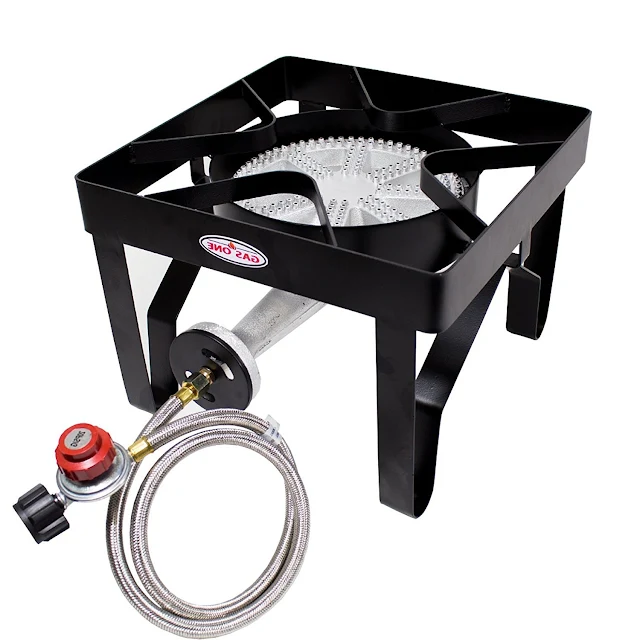
| GasOne B-5450 | Up to 200,000 BTU/hr | Large outdoor boils and brewers prioritising raw heat | High output and heavy cast-iron burner | High input does not guarantee efficient heat transfer |
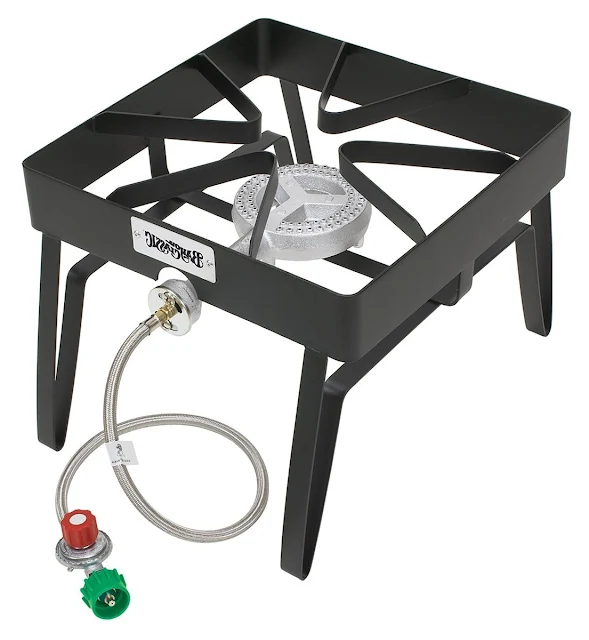
| Bayou Classic SQ14 | 41,000 BTU/hr on the current manufacturer page | Smaller batches and patient brewers using appropriately sized pots | Simple 16-inch square frame and broad flame control | Slower heating and current manufacturer availability varies |
| Edelmetall Brü | 72,000 BTU/hr on established listings | Brewers who find a complete genuine unit at a sensible price | Needle-valve control and distinctive finish | Patchy availability and less heat than newer premium rivals |
Specifications checked in July 2026. Confirm the model number before buying because older retailer pages sometimes publish different BTU figures or bundle a different regulator and hose.
How much burner power does a home brewer need?
A BTU is the energy required to raise one pound of water by one degree Fahrenheit. Burner listings normally state BTU per hour, which describes fuel input under specified conditions. It does not describe how much of that heat reaches the wort.
Flames travelling beyond the base of the kettle are heating the air and the sides of the pot. Wind strips heat away. A narrow burner under a wide kettle can create a concentrated hot zone, while an oversized burner beneath a small kettle wastes fuel. Real boil time therefore depends on burner efficiency, kettle diameter, batch volume, starting temperature, wind, ambient temperature and regulator performance.
| Finished batch | Typical pre-boil volume | Practical starting range | Buying priority |
|---|---|---|---|
| 5 US gallons | About 6 to 7.5 gallons | Roughly 50,000 to 80,000 BTU/hr | Control, quiet operation and low fuel waste |
| 10 US gallons | About 12 to 15 gallons | Roughly 80,000 to 140,000 BTU/hr | Kettle support, flame coverage and recovery speed |
| Larger than 10 gallons | More than 15 gallons | Often 140,000 BTU/hr or more | Rated stand capacity and a system designed around the kettle |
These ranges are starting points rather than promises. An efficient 80,000 BTU burner can outperform a poorly matched 200,000 BTU unit. Once a rolling boil is established, the correct setting is the lowest flame that maintains the evaporation rate your recipe requires.
What matters more than the BTU number?
- Kettle support: Measure the kettle base and compare it with the actual contact points on the frame. The pot should sit level without balancing on an edge.
- Filled weight: Wort is heavy. Add the kettle, fittings and accessories before judging whether the stand is adequately rated.
- Flame control: A burner needs enough adjustment to approach the boil gently and maintain it without repeated boilovers.
- Flame pattern: Heat should cover useful kettle area without climbing around valves, sight glasses or thermometer fittings.
- Regulator and hose: Use the pressure, hose and fittings supplied or approved for that exact burner and fuel.
- Wind performance: A stable blue flame in normal outdoor conditions saves time and gas. Use only the maker's heat or wind shield.
- Working height: Low stands are stable but may require a pump for transfers. Leg extensions must be designed and rated for the burner.
- Material: Painted steel is economical but can lose its finish and rust. Stainless steel costs more and normally tolerates outdoor brewing better.
Check the kettle before buying the flame
A wide, stable brewing kettle with enough headspace makes burner control easier. A pot filled close to its rim can boil over even when the regulator offers excellent adjustment.
Blichmann HellFire Floor Burner

GasOne B-5450 200,000 BTU Burner
Bayou Classic SQ14 Patio Stove
Edelmetall Brü Burner

Gas burner safety on brew day
A brew kettle may contain 25 to 60 litres of near-boiling wort. Combine that weight with an open propane flame and a pressurised fuel cylinder, and ordinary cooking shortcuts become unacceptable.
- Brew fully outdoors. Keep the burner away from walls, fences, branches, roof overhangs, windows, doors and air intakes according to its manual.
- Use a level, non-combustible surface. The frame must remain flat and stable before the filled kettle is lifted into place.
- Inspect the fuel system. Replace cracked, abraded, heat-damaged or leaking hoses and regulators. Keep the hose away from hot metal.
- Leak-test the connections. Use soapy water and look for growing bubbles. Never search for a gas leak with a flame.
- Keep the cylinder upright and away from heat. Do not place it under the burner or where escaping heat can warm it.
- Follow the maker's lighting sequence. Keep your face and hands away from the burner during ignition.
- Stay beside the burner. A boilover can extinguish the flame while gas continues to flow. Shut the gas off and allow it to disperse before attempting to relight.
- Create an exclusion zone. Children, pets and distracted adults should remain well outside the area occupied by the burner, kettle, hose and cylinder.
- Wear enclosed footwear and heat-resistant gloves. Keep a suitable fire extinguisher accessible without placing it beside the burner.
- Turn the cylinder off after brewing. Let the entire system cool before moving, cleaning or storing it.
Never assume a regulator is interchangeable
Burners operate at specified pressures and use region-specific cylinder fittings. Propane is a form of LPG. Natural gas is a different fuel with different pressure and combustion requirements. Use the complete hose and regulator assembly approved for the burner, and use a manufacturer-approved conversion kit or competent gas professional when a genuine conversion is supported.
Common burner questions
Will a 200,000 BTU burner boil twice as fast as a 100,000 BTU burner?
Only if the complete system delivers twice as much useful heat into the wort, which is unusual. Burner efficiency, kettle area, wind and flame overshoot narrow the real difference. A larger burner is most useful when it can heat a larger kettle efficiently and still turn down cleanly.
Why is the flame yellow and the kettle turning black?
A healthy propane flame should generally burn blue. Persistent yellow flame and soot can indicate poor air mixing, a blocked orifice, incorrect fuel pressure or another fault. Turn the burner off and follow the cleaning and adjustment instructions in its manual. Do not modify the jet or air shutter based on guesswork.
Should I fit tall leg extensions?
Extra height can make gravity transfers easier, but it raises the kettle's centre of gravity. Use only extensions designed and rated for the burner. A low stand combined with a brewing pump is often the safer layout for a large batch.
Can I build a windscreen around the flame?
Use only a shield supplied or approved by the burner manufacturer. A tightly improvised enclosure can redirect heat towards the hose, regulator, cylinder or kettle fittings and can restrict combustion air. Relocating the brew to a naturally sheltered outdoor position is safer than wrapping the burner in scrap metal.
How can I prevent extract from scorching?
Turn the burner off before adding malt extract, stir until it is fully dissolved and check the bottom of the kettle before relighting. A powerful burner applied beneath undissolved extract can produce localised scorching even when the rest of the wort is moving.
Which burner should you buy?
Choose the Blichmann HellFire when brewing is a long-term hobby and control, efficiency, kettle retention and corrosion resistance justify the premium. Choose the GasOne B-5450 when a stable kettle fits its square frame and high output matters more than brewing-specific refinements.
Choose the Bayou Classic SQ14 for a smaller kettle and a more measured heat source, provided its slower performance suits the batch. Consider the Edelmetall only when a complete genuine unit is available at a price that reflects its 72,000 BTU output and uncertain parts availability.
The buying rule that prevents the worst mistake
Measure the kettle base, calculate its filled weight and check both against the burner's stated support dimensions and capacity. Extra BTU can shorten a heating stage. It cannot make an unstable kettle safe.
Some product links on this page are affiliate links. If you buy through them, the site may earn a commission at no extra cost to you.
